Showing posts with label politics. Show all posts

Saturday, September 12, 2009

Franklin Pierce's Miserable Legacy Celebrated in Song

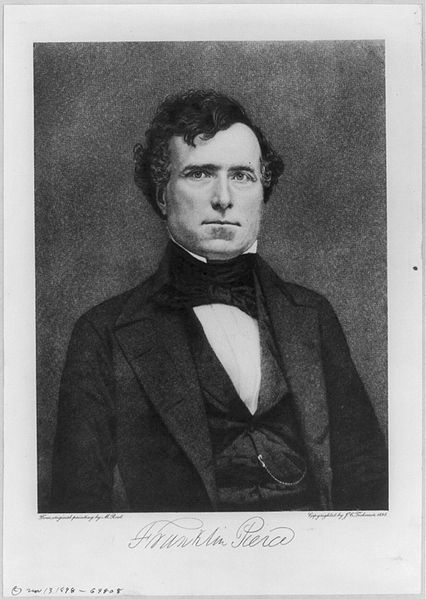
Fellow Franklin Pierce aficionado David Holzel has shared with the editorial staff of this blog (me, myself, and I) the breaking news that Handsome Frank is prominently featured in a song slated for release in November of 2009. That's right, Handsome Frank fans--singer-songwriter Christine Lavin has penned a paean to the current White House occupants titled "Attractive Stupid People." Lest stunned supporters of the 44th President start running their Priuses (or is that Prii?) into bridge abutments when they hear this news, let me hasten to add that the song mentions the Obamas only briefly as pretty people with brains, as opposed to the likes of the 14th President, who skated into office on good looks and charm. The song, not surprisingly, was composed after the writer heard Sarah Palin speak.

I never thought I would hear the phrase "Ostend Manifesto" in a contemporary song, or a song of any kind, for that matter. Yet there it is in Ms. Lavin's catchy little ditty, which is available for preview at her web site. She is to be congratulated for historical accuracy. Not only did she avoid the pitfall of believing that Franklin Pierce ran over a woman during his presidency, she went so far as to go beyond the internet for fact-checking. Writing in the Sunday Washington Post, Gene Weingarten explains how Ms. Lavin asked him whether Pierce had actually signed the Ostend Manifesto (a scheme cooked up for taking over Cuba put together by Pierce's subordinates), and how Mr. Weingarten earned credit for co-writing "Attractive Stupid People" when he suggested the final verse to Ms. Lavin. The complete article, "Lyrical Miracle," is quite entertaining and is available online.

Wednesday, February 11, 2009

Pierce On Jeopardy Again

The excitement was palpable on the set of Jeopardy tonight as the Double Jeopardy categories were revealed.

Not really, but I got interested when one of the categories was "The Gadsden Purchase."

Sure enough, the $800 answer was:


Deepak rang in, and gamely offered the question, "Who was Buchanan?"


Close, Deepak, but no cigar. You were one administration late. Neither of the other contestants tried.

The answer, of course, is none other than our obscure 14th POTUS, Franklin Pierce!

The Gadsden Purchase

The story of the Gadsden Purchase is pretty interesting. It was driven by the desire for a transcontinental railroad via a southern route. The story involves war, diplomacy, Indian raids, the slavery debate, the gold rush, etc. I'd love to recount it here, but it would be too much work, so I'll just refer the reader to a thorough Wikipedia article about the Gadsden Purchase.

Monday, February 2, 2009

An Early Example of the Dissing of Franklin Pierce

From the January 16, 2009 Chicago Tribune article, "10 Things You Might Not Know About Inaugurations:"

The outgoing president often gets little attention, but rarely has it been as obvious as in 1857, when James Buchanan succeeded Franklin Pierce. The swearing-in ceremony had to be delayed for 20 minutes because officials forgot to pick up Pierce at his hotel and had to go fetch him.

Tuesday, January 20, 2009

Pierce and Guano in the LA Times


The Sunday LA Times included a feature with a little different twist on usual top or bottom Presidential lists. Historians who have written about great Presidents were asked about the failings of those Presidents, and historians who have written about "failed" Presidents were asked about good things those Presidents did:

Franklin Pierce

1853-1857

Pierce enabled the expansion of slavery in the West. He also secretly plotted to acquire Cuba from Spain. A drinker of some renown, he was referred to derisively as "hero of many a well-fought bottle."

The best thing Pierce did as president had to do with excrement. Specifically, guano, or bird droppings, which were so essential to U.S. agriculture in the mid-1800s that the era is sometimes referred to as the Golden Age of Guano. In 1856, Pierce signed the Guano Island Act, which allowed U.S. citizens to mine guano on any unclaimed island in the world. It was a time of expansion, and what the guano law did was enable the U.S. to claim rights to whatever land it wanted, as long as somebody else didn't already own it. It was a very smart move -- if you like empires.

-- Larry Gara

Author, "The Presidency of Franklin Pierce"

Saturday, January 3, 2009

Handsome Frank Elevated by Dubya?


Thanks to The Commander Guy's Lair for pointing out Daniel Barrick's article, "The future of Pierce's legacy looks bright: Some historians say Bush will trump him as worst president," in the December 30, 2008 Concord Monitor. Barrick writes:
Michael Holt, a history professor at the University of Virginia who's writing a new Pierce biography, warned Pierce fans against hopes of historical redemption. Bush's slide in the presidential rankings "may move Pierce up a notch, but I'm not sure it will move him out of the bottom five," he said.
Holy cow! Maybe David H. was right when he commented on a previous post, "Someday, everyone will have written a biography of Franklin Pierce."

Sunday, November 30, 2008

The Great Pierce Barbecue of 1852

The occasion of Franklin Pierce's 204th birthday on November 23, 2008 prompted me to take to the Misinformation Superhighway, otherwise known as the internet, to see what new facts or fallacies I might learn about our obscure yet intriguing fourteenth President. A search on his name led me to the Voir Dire Blog, which regularly features "This Day in Presidential History" articles. The entry for the 23rd included the following about the "Pierce Barbecue Pit" in Hillborough, NH, Pierce's hometown:
Located just beyond the famed Kemps Truck “museums” (open exhibit, and can be found on River Street, the first right). The remains of this stone pit were used for Benjamin Pierce’s annual barbecue, and to stage a huge celebration to send Franklin off to Washington.
Clicking a link to the source of the quote, I found that these words were from a pdf file, "The Franklin Pierce Highway: NH 9," published by the Franklin Pierce Bicentennial Web Site. This brief, ambiguous, poorly-written paragraph left me with more questions than answers. What is the meaning of "open exhibit, and can be found on River Street, the first right?" Did Franklin's father Benjamin really have an annual barbecue? Or did some other Benjamin Pierce have an annual barbecue in the remains of the stone pit? Was there really a huge celebration to send Franklin off to Washington? Which time--when he went to Washington as a Congressman, a Senator, or President? He left New Hampshire for Washington in Febuary 1853 to prepare for his March inauguration, and it seems unlikely that a barbecue would be a popular event in the dead of a New England Winter.

My first task was to find out about the Kemp Truck Museum. I had the great good fortune, via Google, of finding Steve Davidson's blog, Crotchety Old Fan. The main focus of Steve's blog is science fiction, but he happened to write about a collection of antique radios and televisions in his hometown of Hillborough, NH, and at the end of the article he also mentioned a Linn van parked at the Kemp Truck Museum, which, Steve stated, was about two blocks from his house. Incredible!

I promptly emailed Steve to see if he would take a picture of the barbecue site for me. He was very accommodating and agreed to take pictures, although he had never seen the remains of the barbecue. More Googling on my part ensued. I was able to find a panoramic map of Hillsborough in 1884. The final item (circled in red below) in a list of 28 local features on the map was "Old Oven Built for Pierce Barbecue 1852." Bingo!


I was also able to locate, at Google Books, a digital copy of The History of Hillsborough, New Hampshire, 1735-1921, Vol. 1, by George Waldo Browne. There I found not only a description of the barbecue, but a picture of the oven, which at some point between the 1852 event and the publication of the book in 1921 had been restored by the local chapter of the DAR.


Further investigation revealed that the barbecue was not held to celebrate Franklin Pierce's departure for Washington, but was a campaign rally held on August 19, 1852. As many as 25,000 people attended the event, although opposition newspapers estimated the crowd at 10 to 12 thousand. A stage 60 by 120 feet and five feet high was built for the numerous speakers who appeared, a large tent was erected, and arrangements were made to provide the attendees with plenty of food and drink. Three thousand pounds of bread were ordered to feed the crowd. At least one, and possibly more, cattle were slaughtered to be cooked in the oven, which, according to the panoramic map description, was specially constructed for the event, and according to one biography of Pierce, was not used again. I could find no documentation that Benjamin Pierce had anything to do with the construction or use of the oven.

As promised, armed with the map, Steve was able to locate the Old Oven, on the banks of the Contoocook River, right next to the Kemp Truck Museum.


Photo Credit: Steve Davidson

The moral of our story: The internet is an uncontrolled mishmash of misinformation, but also a tool for discovery of the truth. Use it wisely, and you will be rewarded.

Hair Force One, Part 3 or Hair to the Chief

Statue of Franklin Pierce, prior to installation on the statehouse lawn at Concord, NH

In previous posts, I have discussed Franklin Pierce's hair, a topic which has fascinated historians and sparked spirited debate among cosmetologists for decades. I can't take full credit for the title of the current post. An occasional reader of this blog, Daniel P. Cory JD (an abbreviation which once may have stood for juvenile delinquent, but now indicates he is a full-fledged lawyer), suggested the title "Hair to the Chief" when commenting on one of the said previous posts. I was conflicted as to whether to use that as the title of the current missive, or to use "Hair Force One, Part 3," since two previous posts were "Hair Force One" and "Hair Force One, Part 2." I have gotten some hits to the blog via Google from people searching for Hair Force One. I assume most of them are looking for a heavy metal band by that name. Unfortunately, I just made a disturbing discovery by Googling "Hair Force One 3" myself. Topping the list of links is a site selling a series of adult movies entitled "Hair Force One." So maybe some of those people who land here via Google are looking for something other than loud music. Whatever. If it means more page views, I'll continue to use the phrase.

But, as usual, I digress.

I decided to follow the shining example of the writers of the 1960s cartoon, Rocky and Bullwinkle, and use both titles, as they frequently did. Examples include:

Axe Me Another or Heads You Lose!
Avalanche is Better Than None or Snows Your Old Man
The Deep Six or The Old Moose and the Sea

And on and on. Brilliant!

What was I talking about? Oh yeah, the hair of Franklin Pierce, 14th President of the USA. While researching another Pierce topic, soon to be revealed in a separate post, I found an article in the May 19, 1900 Fitchburg (Mass) Daily Sentinel in which F.C. Currier writes about meeting Franklin Pierce during the Presidential campaign of 1852. Currier described Pierce as follows:

He was tall and of slender build, with erect, military bearing, black hair, standing up somewhat in curls.
So there you have it. Another foray into the obscure. Hair today and gone tomorrow! Hey wait a minute! It's another title. . .

Tuesday, August 19, 2008

Franklin Pierce in Another Top Ten List!


Franklin Pierce is No. 5 in the Top Ten Heads of Presidential Hair at the blog Receiving Me?.

Wednesday, August 13, 2008

Franklin Pierce in a Top Ten List!


Franklin Pierce appears in the top ten of a Presidential list! He is the sixth youngest man, at age 48 years, 101 days, to assume the office of U.S. President.

We can thank the mother of NPR's Farai Chideya for this list.

Sunday, August 10, 2008

A Bobblehead Brouhaha

As I wrote in an earlier post, I am the proud owner of a Franklin Pierce bobblehead purchased from the New Hampshite Historical Society.

Young Hickory of the Granite Hills, as Pierce was known, was New Hampshire's only favorite son to attain the office of President of the United States (1853-1857). Last month, the NHHS added two politically incorrect bobbleheads of 17th century historical characters to its museum store inventory. An assistant administrator of the society has resigned, and another employee refuses to work in the store as a consequence of these new offerings. Either of the new bobbleheads individually would be found objectionable by certain segments of the population, but the simultaneous release of the two seems particularly ill-advised.

The first new bobblehead is Hannah Duston. Here is a brief synopsis of her claim to fame from the blog of Fiona Broome:
One of the most horrific attacks occurred on March 15, 1697, when Indians burned six homes and killed or captured at least 39 people. Many of the victims were buried in Pentucket Burial Ground on Water Street, almost across the street from Buttonwoods. . . . (The Pentucket cemetery was established in 1668, and has many old and unmarked graves.) That was the same attack in which Hannah Dustin (or Duston) was captured, along with her newborn daughter, Martha, and Mary Neff, Hannah’s midwife. For 15 days, they were marched in freezing March weather. After Hannah’s six-day-old baby was brutally killed by Abenaki Indians, Hannah Dustin and Mary Neff were joined by another captive, 14-year-old Samuel Lennardson. Hannah avenged her daughter’s murder by organizing a revolt one night. With a hatchet, Hannah killed and scalped nine of the 10 or 12 Indians they ambushed. Among Hannah’s Native captors, only one woman and a young man escaped the attack. Hannah, Mary and Samuel seized a canoe and reached the nearest colonial settlement where they presented the scalps to the British authorities, for a reward of 50 pounds. Hannah’s story has been the subject of controversy. Some describe her as a hero while others are less flattering. Nevertheless, a Haverhill statue commemorates her history, and —though the story is disputed — she may be buried in an unmarked grave in the Pentucket Burial Ground.
The statue above, upon which the bobblehead is based, stands in Haverhill, Massachusetts,and is said to be the first statue in America memorializing a woman. Hannah holds a hatchet in her right hand.

Fortunately, the NHHS did not choose as a model an even more graphic statue which stands at the site of Hannah's grisly escape at Penacook, NH. Here she holds not just the hatchet in her right hand, but bloody scalps in her left.


The other new bobblehead is Chief Passaconaway, of the Penacook Tribe, a peaceful and powerful leader of his tribe in the 17th century. Some people have pointed out that the style and color of his hat are reminiscent of a smurf.


In defense of the NHHS, the hat looks a lot like the one worn by the chief in this engraving.
.
The choice of color could be debated, but the director of the NHHS has stated he thinks Indians of that time period may have worn a similar color. Besides, Smurfs' hats are white; their skin is blue.

Although the appearance of the bobblehead is objectionable to some people, even more disturbing is its release at the same time as the bobblehead of a crazed Indian scalper.

One of the interesting things I discovered while researching Passaconaway is that fact that William James Sidis, one of the most intelligent Americans ever, wrote a book about the chief under the pseudonym of Charles Edward Beals, Jr. I hope to devote a separate post to Sidis (1898-1944) in the near future.

Tuesday, August 5, 2008

Truman on Pierce

I found the following quote from Harry Truman at Manus Hand's interesting web page, Dead Presidents on Dead Presidents:

Pierce was a nincompoop.... It was Pierce's foolish notion that he could cool down the slavery question and make people forget about it by doing two things: filling his cabinet with people of different viewpoints, and concentrating almost entirely on foreign policy and territorial expansion instead of slavery problems. But the net result was that his cabinet members kept bickering with each other and didn't accomplish much, and Pierce's moves in other directions didn't distract people's attention from the slavery problems for a minute.... Pierce was one of the best-looking men ever in the White House. He was also one of the most vain, which I guess was on account of the fact that he was so good-looking. But though he looked the way people who make movies think a president should look, he didn't pay any more attention to business as president of the United States than the man in the moon, and he really made a mess of things.... Pierce was the best looking President the White House ever had -- but as President he ranks with Buchanan and Calvin Coolidge.
Harry sure gave 'im hell.

Saturday, July 19, 2008

Guano Diplomacy

Millard Fillmore

Whenever one nation possesses a commodity coveted by another nation, conflict ensues. Thus it was with guano during the nineteenth century. In his 1852 State of the Union address, Millard Fillmore said:

The correspondence of the late Secretary of State with the Peruvian charge d'affaires relative to the Lobos Islands was communicated to Congress toward the close of the last session. Since that time, on further investigation of the subject, the doubts which had been entertained of the title of Peru to those islands have been removed, and I have deemed it just that the temporary wrong which had been unintentionally done her from want of information should be repaired by an unreserved acknowledgment of her sovereignty.

I have the satisfaction to inform you that the course pursued by Peru has been creditable to the liberality of her Government. Before it was known by her that her title would be acknowledged at Washington, her minister of foreign affairs had authorized our chargé d'affaires at Lima to announce to the American vessels which had gone to the Lobos for guano that the Peruvian Government was willing to freight them on its own account. This intention has been carried into effect by the Peruvian minister here by an arrangement which is believed to be advantageous to the parties in interest.
Daniel Webster

The "late Secretary of State" was none other than Daniel Webster. On June 2, 1852, a Captain John C. Jewett sent a letter to Webster asking whether American citizens could take guano from the Lobos Islands in the Pacific. Webster replied in a letter dated June 5, 1852, that it was the position of the Department of State that neither Peru nor any other country had legal claim to the Lobos Islands and the guano thereon, and on the same day, Webster sent a letter to the Secretary of the Navy, suggesting the Navy protect anyone obtaining guano from the Lobos. As events unfolded, much hue and cry arose over Webster's first letter to Jewett, authorizing Americans to harvest guano from the Lobos Islands, and whether President Fillmore had approved the letter. A draft of the letter initialled by Fillmore was subsequently found, although he denied any recollection of approving it. The controversy was taken up by the press in the U.S., as well as in Peru, as shown in this excerpt from a letter from the American Chargéd'Affaires in Lima.
Text not available
Reports of Committees 30th Congress, 1st Session - 48th Congress, 2nd Session By United States Congress. Senate

Extensive correspondence between Peru and the U.S. convinced the U.S. government that Peru in fact owned the Lobos, and Webster reneged on his promise of Naval protection for Jewett, much to the chagrin of Capt. Jewett and his partner Mr. A.G. Bensen, who chartered several vessels to go to the Lobos under the protection implied by Webster's promise to Jewett. When Bensen's ships arrived at Peru, they were not allowed to take guano from the Lobos Islands, but a deal was struck whereby they could load guano at the Cinchas Islands, and Bensen was to be paid 20 dollars a ton by the Peruvians for hauling the guano. The deal did not go smoothly, and Bensen evetually filed claims against the U.S. government and Peru. The claims were considered by the Committee of Claims of the Senate in 1856 and 1857, but I haven't yet been able to find the ultimate outcome.

Sunday, July 13, 2008

Franklin Pierce and the Golden Age of Guano

Among historians, Franklin Pierce consistently ranks among the worst Presidents of the United States. Part of his infamy arises from a crucial piece of legislation he signed--the Kansas-Nebraska Act of 1854. The act established the territories of Kansas and Nebraska, and allowed each territory to decide whether to allow slavery, effectively negating the Missouri Compromise of 1820, which outlawed slavery north of latitude 36 degress, 30 minutes. Violence erupted between advocates of slavery and freesoilers in the Kansas territory, leading Horace Greeley to coin the phrase "Bleeding Kansas." The violence in Kansas was a prelude to the Civil War.

Politicians forcing slavery on a freesoiler (L to R): Steven A. Douglas, Franklin Pierce (pulling the beard), James Buchanan, Lewis Cass

The historical impact of the Kansas-Nebraska Act overshadows another significant law enacted during the administration of Pierce--The Guano Islands Act of 1856. Yes, this is a law that deals with bird droppings, but which also had a lot to do with American expansion.

As a fertilizer, guano was essential to the agricultural economy of the U.S. during the period from 1840-1880, sometimes called, with a completely straight face, The Golden Age of Guano. Pierce's predecessor, Millard Fillmore, had this to say on the topic in his State of the Union Speech in 1850:

Peruvian guano has become so desirable an article to the agricultural interest of the United States that it is the duty of the Government to employ all the means properly in its power for the purpose of causing that article to be imported into the country at a reasonable price. Nothing will be omitted on my part toward accomplishing this desirable end. I am persuaded that in removing any restraints on this traffic the Peruvian Government will promote its own best interests, while it will afford a proof of a friendly disposition toward this country, which will be duly appreciated.

Franklin Pierce also brought up the topic in his 1853 State of the Union speech:

A new branch of commerce, important to the agricultural interests of the United States, has within a few years past been opened with Peru. Notwithstanding the inexhaustible deposits of guano upon the islands of that country, considerable difficulties are experienced in obtaining the requisite supply. Measures have been taken to remove these difficulties and to secure a more abundant importation of the article. Unfortunately, there has been a serious collision between our citizens who have resorted to the Chincha Islands for it and the Peruvian authorities stationed there. Redress for the outrages committed by the latter was promptly demanded by our minister at Lima. This subject is now under consideration, and there is reason to believe that Peru is disposed to offer adequate indemnity to the aggrieved parties.

Peruvian guano was desirable because the seafood diets of seabirds such as the Peruvian booby and the Guanay cormorant are rich in plant nutrients, and the dry climate along the coast of Peru results in the guano drying quickly, making it relatively odorless, and preventing nitrates from evaporating away.

While the finest kind of guano came from Peru's Chincha Islands, other small islands were potential sources. I grew up on a duck farm, and I can testify to the prodigious amounts of manure produced by large numbers of birds confined to a small area. Several small islands frequented by seabirds in the Pacific and Caribbean were collectively known as the Guano Islands.


Peruvian Booby

So, in 1856, to promote the agriculture necessary for westward expansion, Congress passed, and Franklin Pierce signed, the Guano Island Act, which allowed U.S. citizens to mine guano (deposits which had been accumulating for thousands of years could be up to 150 feet deep) from any island, rock, or key not under the jurisdiction of another government. The U.S. would annex the island and protect the rights of the discoverer to occupy the island and mine the guano. The Act also stated the U.S. could give up possession of a guano island it at any time. Although not explicitly stated, Congress was making sure that the U.S. could dump any guano island when its resources were all used up.

Franklin Pierce was, or course, incorrect when he referred to "inexhaustible deposits of guano," and the disruption of the ecology of guano islands resulted in dwindling supplies. That, plus the industrial production of fertilizer, brought the Golden Age of Guano to an end around 1880.

Peruvian guano is in the news again today, as prices of synthetic fertilizers skyrocket. Peruvians are collecting what little guano is found on offshore islands as fish populations and the populations of seabirds which feed on them have dwindled. See the New York Times article "Peru Guards Its Guano As Demand Soars Again".

Wednesday, July 2, 2008

Franklin Pierce - Whipping Boy of Pundits and Naysayers


Once again, the name of Franklin Pierce comes up in the political blogosphere this election year. In her article, "Wes Clark and the Military Credential," in the TIME/CNN blog Swampland, Karen Tumulty discusses the men who had military experience as generals before being elected U.S. President. General Wes Clark recently said that John McCain's military service didn't necessarily mean he would be a good Commander-in-Chief, which set off a firestorm of chatter in the media. Ms. Tumulty, taking the same exhaustive, thorough approach to journalism that I do, used Google to find out how many U.S. Presidents had been generals, and how those Presidents ranked in a survey of historians, political scientists and legal scholars that the Wall Street Journal and the Federalist Society did in 2000. Please note that John McCain was not a general, the world changed quite a bit between the time of George Washington and Dwight D. Eisenhower, and I personally believe this whole discussion is irrelevant.

In any event, Ms. Tumulty notes that of the twelve former generals who became President, "...two were flat-out 'failures': Franklin Pierce (Mexican War) and Andrew Johnson (Civil War)." Poor Franklin Pierce--Rodney Dangerfield got more respect than this guy.

Tuesday, June 17, 2008

Franklin Pierce Rising


Perhaps Franklin Pierce will rise from obscurity this election season. He is getting some publicity now. In the June 13, 2008 edition of the Christian Science Monitor, Ruth Walker writes in an article about the "historic" campaigns of Barack Obama and Hillary Clinton entitled "Not Quite the End of 'History',"
It is a moment to savor in the life of the nation. But is history the facts, the deeds themselves; or the telling of them? Of course they made history, one wants to say; the US presidency is always "historic." Consider Franklin Pierce, the obscure 14th president. Amazon lists a dozen biographies of him, including a new one due out in August, plus two compilations of his papers.
After checking on Amazon.com, it looks to me like the book being published in August is a recycling of a biography for children written by Steven Ferry in 2001, but at least the publisher is optimistic enough to think that children still read books and that they might be interested in history.

Blogger billysumday in his diary had me going for a minute with his parody of a recent John McCain remark. McCain responded to Barack Obama's comment that McCain was running for George W. Bush's third term by saying that Obama was running for Jimmy Carter's second term. Billysumday changed the response to make it Franklin Pierce's second term. The implication is that McCain is old and making outdated references. It may be the case that many young voters are equally unfamiliar with Carter and Pierce.

Finally, in an article about ex-Presidents, Jeremy Lott wrote of Bill Clinton in the blog Politico on May 20, 2008,
He may also be in the same strata as Franklin Pierce, who, though from New Hampshire, was a slavery enthusiast and denounced the Civil War effort to keep the nation united. Pierce died a reclusive alcoholic, a former president scorned even by local schoolchildren, who often threw pebbles at him on the rare occasions he ventured outside.
Little old lady English teacher note: If there are indeed different levels of bad ex-Presidents, then Clinton would be in the same stratum, not the same strata as Pierce, unless it is possible to be so bad as to occupy multiple levels in the hierarchy of former leaders of the free world.

For a nice concise video about Franklin Pierce, check out History.com.